Friday, 19 February 2016

Pre-Production Documents and Planning

The role of producer was given to Carly Curwen (Click here for her blog). Due to this role, Carly has taken the time to write up the pre-production documents needed for this production. The idea that we have collectively agreed to follow (with the help of our fellow students) is the tattoo idea. This is due to the idea being a stronger and more interesting subject, in-terms of the narrative and the amount of contributors that have for this subject in contrast to the drugs idea.

Here is the list of pre-production documents created for this project:

We have also done further research into the subject of tattoos for our documentary idea by looking into similar styles of tattoo productions. Click Here to view this research.

We plan to travel to Barnsley to interview Sarah who is a tattooist at 'Ink'd Tattoos & Piercings Studio' on the 15th February 2016 with Jodie Foster, a client of Sarah's and a contributor for our documentary. We also plan to film several contributors to give us a range between age, style and personal meanings to help drive our narrative.

Curwen, Carly (2016). Pre-production [online]. Last updated 9th February. http://carlycurwencreativeproject.blogspot.co.uk/2016/02/pre-production.html

Thursday, 4 February 2016

What is Synced Sound and Why Will I Use it?

Shot gun mic on a boom pole for a
Synced Sound Setup
Synced sound is the practise of recording sound via a microphone (either it be a shot gun mic, clip mic etc) that records straight to camera and ‘in-sync’ with my footage. This technique is used to record crisper and cleaner sound for your footage with a better quality mic then you standard build in mic. This is a more affective way as it allows the boom operator to get the mic closer to the subject to pick up the sound waves at the optimal distance to record super crisp sound. Although, I would prefer the use of a shot gun microphone as it records direct sound when pointed at the sound source.

Diagram of a shot gun microphone's
polar pattern
To get the mic closer to the subject, the best technique is to have the mic on a boom pole and positioned above/slightly in front of the subject pointed directly at the sternum for maximum clarity to capture the most sound waves/frequencies. This is because the way the directional mic records sound is by being pointed directly at the source of sound, and vocals are clearer from the sternum.

I will be using this technique in my production as it will allow me to record the vocals of my interviewee in sync with my footage and saves the editor to sync up sound in post. This creates a faster and simpler work flow for time efficiency and to get the best quality for our production.

Friday, 29 January 2016

Two Documentary Pitch Ideas

After receiving the brief for this module, we were asked to come up with two ideas for a short documentary. As a production team we had an in depth meeting discussing different subjects we could based our documentary on and be interesting for views. After many different subjects we decided on two ideas.

Tattoo


This idea follows questions such as; why people get them? Do they affect your career? Is it worth it? etc. These questions will be answered by Sarah a tattoo artist at Ink'd Tattoo & Piercing Studio and Jodie Foster a client of Sarah's. The narrative and purpose for this documentary can be seen in the treatment below.


Click Here for the documentary pitch for Tattoos

Tattoo - Treatment


The narrative is going to be based around a middle twenty year old female tattooist called Sarah who works at Ink'd tattoo at Barnsley studio since 2013, she is going to discuss with us what she finds appealing about tattoos and what significance certain ones can mean for her or her clients. We will also be introduced to Jodie who is a 19 year old student but has been getting tattoos since the age of 16 and will also discuss the personal stories behind some of her favourites as well as discussing her relationship with Sarah who has been doing her tattoos for over a year.

Other contributors will consist of 20 year old Jakob Trott, 18 year old Jack Done and Victoria Knaggs who is also 18. All three of them who are studying various subjects at Sheffield Hallam University. They will be discussing their body ink, telling us stories about their first tattoos, what inspires and motivates them to get the permanent body modification and what their families and friends thought once they first made the leap. We will be going to the tattoo studio Ink'd in Barnsley to do the interview with Sarah, our main interviewee in the documentary, to discuss with her what its like to be a female tattooist in the mainly male industry. She will also be discussing with us as well as our contributors about any significance around her tattoos and what appeals her to them. We will shoot our small contributors such as Jodie in different locations but with the same background by using a mandala wall hanging to keep a continuity going throughout the documentary.

We are wanting to keep a dark/gothic theme throughout the documentary and really concentrate on the traditional tattoo style. We also aim to have close up of our contributors and Sarah's tattoos to put around the documentary and also had visuals for the audience when they are discussing their art.  We will also get cut away shots of around Sarah's tattoo studio such as her artwork on the walls, all her gear and equipment that she uses and photos on her wall of friends and family. This will give the viewers a more intimate feeling towards her, and give a personal insight of what her life is really like and her personality whereas the other contributors won't have this kind of background as they aren't our main characters in the documentary.

---------------------------------------------------------------------------------------------------------------------


Drugs


This idea follows the questions, why do people use drugs? How do people get them? Are drugs easily accessible What drugs are most commonly used in the Sheffield area? etc. we will look into these questions by asked them to the people who deal the drugs and the people that buy the drugs. For more information please see the treatment below.


Click Here for the documentary pitch for Drugs

Drugs - Treatment

This documentary approaching use and affects of drugs will take a realistic approach and highlight the dangers of drug taking and how they can affect your health and your career. One thing in particular that we looked it as where you can get drugs and how accessible they are, and one thing that we've found out is that in some places in Sheffield you’re never more than stone’s throw away from someone either abusing or dealing drugs; especially when it comes to clubbing. From our point of view looking at how accessible drugs are in Sheffield is more common knowledge than anything else and would be an easy thing to incorporate into the documentary. There’s also been a case recently where a footballer that plays for Sheffield United has received a six-month ban because of an illegal substance found when he was taking a drugs test.

Another point we’d be looking at in the documentary s the different types of drug consumption. As a group it’s likely that we would all know someone who’s taken recreational drugs at least once in their life and as a result of this, we would be able to talk to those people and gain their knowledge. However we understand that this would be a difficult hurdle to get over as a lot of people might not be willing to share their experiences.

This result is something that could potentially harm our approach to the documentary. We realise that drug use is a controversial and very disputed subject and we need to be very careful with the content that we produce and not everyone we approach will be keen to tell us their story or their experiences with drugs. Obviously there are ways to avoid this person being shown (i.e. interview as a silhouette and/or change voice tone) however if the contributor doesn't trust us as film-makers then there’s nothing we can do to change that. However whilst looking at contributors, we feel that it would be a crucial part of our documentary to have a quick interview with a GP, health advisor or someone who can give advice when it comes to the treatment of drugs. By having someone of this calibre, it shows another dimension of the documentary and could potentially reach out to the audience. 

The documentary will have to be presented or at least have a voice-over as there’s lots of facts and pieces of information to be taken in by the viewer and it wouldn't have as much as in impact if we were just trying to tell a story through interviews. If we were to look at drug abuse from a different approach then we could just show stories of how people are affected, some of their most shocking experiences etc. However because we’re trying to come across with a more informational approach it needs to be broadcast in a way that the information can be easily transmitted to the audience.

---------------------------------------------------------------------------------------------------------------------

As a team we was all more passionate about the Tattoo idea over the Drug ideas as we felt it took our interest as individual people, and as a collective group with different point of views on the subject. 

Saturday, 23 January 2016

Documentary Film Analysis: The Apology Line - Dir: James Lees

(Still) Title graphic from
 'The Apology Line' - Directed by James Lees
‘The Apology Line’ is a short documentary directed by James Lees. This short documentary tells the individual stories/apologies of anonymous members of the public that ring into the help like, The Apology Line. 

The Audio is a completion of contrasting apologies from a range of different people. The visual footage is a completion of people doing different actives in their everyday life in the evening/night. This is shot as an artistic fly on the wall style shot, showing people in underwear, getting dressed for bed, cleaning their home etc. This is also mixed with establishing shots of flats to give the scene a sense of an urban environment; this can be seen to give a lower class theme to the people talking on The Apology Line. The Documentary is also shot at night, which gives the apologies a connotation of dirty secrets that people would never say when people are around to hear.

 ‘The Apology line’ to me feels like a documentary on a modern take of the catholic practice of confession to gain forgiveness or to get a personal hypothetical weight off their chest. This documentary connected with me on an emotional level as I could feel the angry, regret and shame in the apologies. I really liked the tones, themes and how the film conveys these anonymous people’s stories. 

Monday, 14 December 2015

Experimental Short Film Evaluation

MIND GAMES is an interesting experimental short film as it divides 3 mental illnesses into 3 minutes. The first scene consists of a man standing in an underpass and having clones of himself jump into his body. The second scene consists of a girl sitting in a kitchen playing with her food. Finally the third shot consists of a man standing in a bridge, changing his facial expression via jump cuts. These scenes are shot well in terms of the composition and colour grading. In contrast, the quality of the footage is blurry at times due to stretching the footage for framing and contains a lot of noise. Also the footage overall is jump running at 15 fps and decreases the flow of the slow-motion, Although the SFX work really well in blending several sections of footage together to create one seamless shot.

I personally worked on editing the video footage and the SFX; I also contributed to 50% of the idea building and research for this project. First we decided to use mental illness for our products' subject, and then we used the website www.mind.org.uk/ to research three mental illnesses (Schizophrenia, Bulimia and Bipolar Disorder). We then discussed what we wanted to happen in each scene. Originally we wanted to do a shot where we have the actor cloned several times shouting at himself in a chair, but we quickly discarded that idea due to the need of a green screen. We instead chose to have clones jump into the actors body, which was very difficult via the technique of masking and Rotoscoping. This technique was the same in the next scene, although the final scene was easy with just jump cuts. Overall the final film was not far off from our original idea after overcoming the green screen issue.

I have learnt from this project to think outside the box and explore ideas as sometimes being adventurous can pay off. We experimented with the technique called Rotoscoping, which involves masking round a section of footage and blending it into separate footage to make one overlaid image. This technique is similar to green screen technique but involved tweaking the mask frame by frame.

I have also learnt to take more of a back seat when working on a project, as I tend to take control of the project and do everything myself. Working with Carly and breaking down the work equally has stopped a lot of the usual stress I encounter when working on a project. Although I still tend to have strong opinion on how things should be done, I feel I am able to trust my colleagues to do well which allow me to focus on my section of the work.

In the terms of team work, I and Carly worked extremely well together by delegating the work 50:50. We divided the work based on the strength, skills and fair equal work load. I personally worked on the post-production video editing and SFX and Carly took control of the filming. We both recorded the audio and Carly edited the recordings together to create the audio piece. We both came up with the idea to use mental illness as the subject of our film and we chose an illness each to research and morphed our findings together for our research.

Click here for the document form of this evaluation.

MIND GAMES - Experimental Short Film (Final Cut)

After several peer assessments involving detailed verbal feedback, I reviewed the latest draft cut of MIND GAMES and applied the required changes to both video and audio. After fixing the exporting problem and exporting in the highest quality out footage will allow, our final cut of MIND GAMES is ready.

Click the links below to watch the final cut edit of MIND GAMES.

Thursday, 10 December 2015

MIND GAMES - Experimental Short Film (Locations and Draft Edits)

After our MIND GAMES audio drama was completed, we started production on our film adaptation. We shot at 3 location for each sections of the film on the 29th November 2015.

MIND GAMES visuals will represent a visual interpretation for each mental illness and will be different from each other but will link to the audio, which will give an audible representation. Each shot will have each actor/actress acting toward the mental illness that their characters suffer from; Schizophrenia, Bulimia and Bipolar Disorder.

The experimental approach for this short film will be structural via each shot containing the same shot. Each shot will consist of 1 continuous shot lasting 1 minute each and will be pull away/zoom out styled shot; starting with a close up of the actor's/actress' face and ending on a wide shot showing the actor/actress and the surrounding scene. This will be done to create a sense of anxiety on the audience as the shot will drag on for to long without cutting. In contrast to this, the shot will be pulling away/zooming out from the actor/actress. This will represent how the character feels enclosed and suffocated by their illness, which is represented by the close up. This will then flow into representing the character feeling alone and isolated with no one to help, which is represented by the wide shot.

The use of close up to wide shot is used to show the emotions of the character and to reveal what is happening to them in their mind by revealing the scene, which represents their mind. for example; Schizophrenia - dark underpass with several people (voices/self manifested emotions), Bulimia - Kitchen, empty with nothing but the character and food (herself vs food) and Bipolar - dark enclosed bridge filled with graffiti, urban and dark (many different emotions/people but only one person).

Location 1 - Schizophrenia: Empty Underpass

About the location:

The underpass is located next to Aldi on St Mary's Gate. The underpass is well lit, looks amazing in a composition and the lines of the lights and tiles helps drag the eyes of the audience to the centre of the scene, which is the character.
Camera position in the underpass for the first scene: Schizophrenia

About the Scene/Shoot:

This scene consists of the main protagonist having manifested clones of himself appear and jump into his body taking over his emotions and beating him physically, emotionally and mentally.

Location 2 - Bulimia: Empty Kitchen

About the location:

The kitchen is located at the Derwent Students / Sheffield Hallam Accommodation, The Trigon on Shoreham Street. We used this kitchen as it was easily accessible but also because the kitchen has a large area, which made the pull away/zoom out technique possible. The lighting in the kitchen also creates a good look as it darkens the background but keep the actress lit, which makes the audience focus more on the actress.

Camera position on the kitchen for the second scene: Bulimia

About the Scene/Shoot:


This scene consists of a girl with Bulimia trying to eat a bowl of pasta and is trying to fight the struggle that is surfacing.  

Location 3 - Bipolar Disorder: Enclosed Railway Bridge
About the location:

The bridge that leads over the railway is located to the right of the train station. This location fits the scene well as it works will with composition and forcing the line of focus onto the actor and looks very dark, urban and gritty. With the use of an open ceiling, natural light flows through the bridge and has a long range of depth, which creates a nice depth of field.
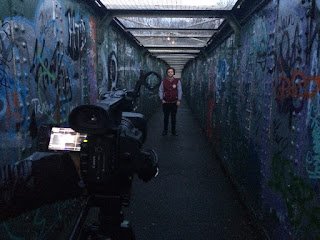
Camera position on the railway bridge for the third scene: Bipolar Disorder

About the Scene/Shoot:
Equipment List:
MIND GAMES Drafts